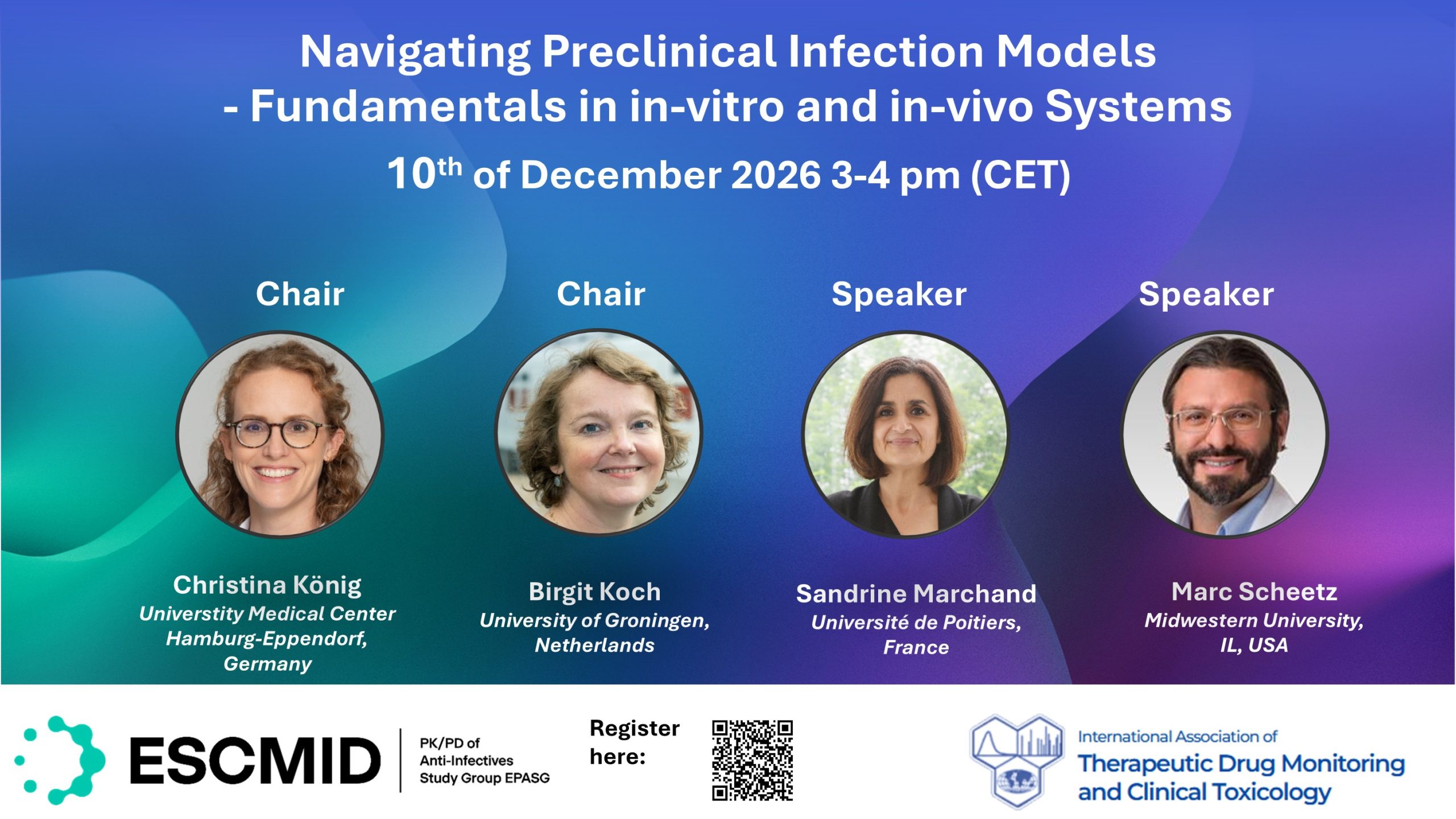
10 Dec 2026
 3-4 PM (CET)
 Virtual Session
Session proposal:
In vitro and animal models often serve as invaluable tools throughout the evaluation and development process including dosing regimens for anti-infectives. This webinar familiarizes participants with the core principles, aids their critical interpretation and identifies key translational opportunities and gaps.
Presentations:
This talk will focus on the different in vitro PK/PD models, including checkerboard assays, time-kill curves, and dynamic models such as the hollow-fiber infection model (HFIM). Each model will be presented with its advantages and limitations, with a more in-depth discussion on the major limitations that remain common to many of these models: we still largely work in rich, standardized culture media, without fully accounting for the physiological environment, the host immune system, or the complex interactions between the host, the pathogen, and the drug.
Sandrine Marchand, Université de Poitiers, France
Building on the in vitro PK/PD models in the preceding talk, this presentation examines what animal infection models add when the host matters, from deriving PK/PD indices and humanizing drug exposure to accounting for immune status and bridging efficacy and toxicity findings to patients. It also reviews recent U.S. and European initiatives to reduce animal testing and asks how to replace animal studies where the scientific question allows, while retaining them where the need is justified.
Marc Scheetz, Midwestern University, IL, United States
Endorsed by:
IATDMCT
Register here: https://us06web.zoom.us/webinar/register/WN_pMcDyi4HRsyrtzdA6w3FGA#/registration
IATDMCT, 4 Cataraqui Street Suite 310
Kingston, ON, K7K 1Z7, Canada